Weekly cleaning
£24per cleaner-hour
3 hours minimum · £72 daytime basePlan weekly cleaning
Make the next cleaning visit about the work you would most like off your hands. For a home around Smithfield, Local House Cleaners can assess a focused set of rooms, a wider regular routine or a one-off service based on the actual condition. You choose what needs attention and any household extras you want considered. We help establish sufficient cleaner-hours, the full price and practical arrangements before confirmation, so the appointment has an achievable purpose rather than a long list competing for too little time.

Moving area names stop while hovered or focused. Press Enter or Space, or tap the moving area, to keep them still after leaving. Activate again to allow movement. Browse the directory for the complete list.
A regular helping hand, a proper reset or a clean before your next move. Choose the work your home needs.
Keep the kitchen, bathrooms and everyday rooms feeling cared for.
Explore regular cleaning02 ↗More time for reachable detail and the build-up that needs extra attention.
Explore deep cleaning03 ↗An agreed empty-property checklist, ready for your next chapter.
Explore tenancy cleaningA clear plan for your Smithfield home, from the jobs you need to an agreed visit.
Add your contact details and save your home address.
Pick your service, tasks and property details. Choose a date and start time, then check the full cost.
Top up from £35, with enough to cover the whole visit. The booking amount is reserved from your balance when you confirm.
Agree the plan and an available time. Your visit details stay in your account.
These are starting points. The final scope, timing and suitable cleaner availability need confirmation.
£24per cleaner-hour
3 hours minimum · £72 daytime basePlan weekly cleaning£26per cleaner-hour
3 hours minimum · £78 daytime basePlan fortnightly cleaning£28per cleaner-hour
3 hours minimum · £84 daytime basePlan one-off cleaning£35per cleaner-hour
4 hours minimum · £140 daytime basePlan deep cleaningEarly starts, late finishes and next-day requests can cost more. The full breakdown is shown before agreement. See timing prices and assessed extras →
Studio & 1 bed from £189 · 2 beds from £269 · 3+ beds & houses from £329
 Smithfield · EC1A
A clean is more useful when the cleaner knows exactly where to start. Pick your rooms, add your priorities and allow enough time for the work.
Ironing and laundry use the same booked time. A long checklist may need more than the minimum visit.
Build my cleaning planHouse, flat or studio—start with what matters most to you.
Think about the tasks that make the next day easier. That might be kitchen surfaces ready for cooking, an attended-to bathroom or floors and reachable dusting in the main rooms. Put those priorities first. The cleaner can then follow a coherent sequence, while you can decide whether an additional household task needs more paid time or belongs outside the appointment.
A room list should reflect what is actually wanted. Include an extra toilet, separate shower or study rather than rely on the bedroom count to explain the whole property. A bedroom may need floors and dusting, a linen change or only one of those tasks. We can assess those choices directly, without assuming every room of the same type needs identical labour.
Smithfield Market is a recognised local landmark, with Central Markets addresses in EC1A. A domestic-cleaning appointment concerns your private home, not the market or a public entrance nearby. Give the complete residential address and full postcode, including building or flat identifiers and the authorised door. A familiar place name can help orientation without establishing permission to enter the property.
Describe whether the request is maintenance, an ordinary one-off clean or concentrated work after areas have fallen behind. Established residue may need a different allowance from later upkeep. There is no reason to hide that condition; it helps us assess an appropriate service. A first appointment is not automatically a deep clean, but a minimum maintenance visit should not be expected to absorb every catch-up task.
You can leave some rooms private while concentrating on the areas you use most. If more than one person lives in the home, settle the priorities and permitted entry together. Identify a practical authorised contact for questions. The cleaner should not need to choose between competing household instructions or decide whether a closed room is available because someone else has asked for the whole home to be cleaned.
Timing should be part of the practical request. Say when rooms will be available, which areas are occupied and whether there is a deadline you would like considered. Those details need assessment rather than a promise that any timetable will work. A useful appointment has enough accessible work and a confirmed arrangement, not simply an early time selected without the rest of the plan.

Name the kitchen surfaces you want attended to: accessible worktops, sink and taps, hob exterior and other agreed reachable areas can form the plan. Mention a splashback or particular fronts if they matter to the result. Condition changes the workload. A surface receiving ordinary upkeep is different from an established patch of grease, so explain where sustained attention is needed rather than ask a general room label to cover everything.
Decide how to make the selected surfaces accessible. You may put food, papers and small belongings away before the visit or ask for limited light straightening to be assessed. The cleaner should not judge what can be thrown away or reorganise private storage without a specific task. Clearing useful work space helps direct the appointment towards cleaning instead of a search for somewhere to put the household's possessions.
Tell us about the materials, relevant care instructions and existing damage. A stone worktop, coated tap or sensitive finish can need an appropriate method different from the surface beside it. Ordinary cleaning does not promise to restore wear or remove every mark. Where suitability is uncertain, the cleaner should be able to clarify it rather than keep applying abrasive treatment until the appearance changes.
At the sink, agree the reachable bowl, taps and draining area, with accessories moved only as discussed. Washing dishes is a quantity of work to describe separately. Several pans can use a different allowance from a few cups and plates. If washing-up is the main help you want, say so before accepting the scope so it can receive time without silently displacing the cleaning priorities.
A hob needs to be safe and cool enough for the agreed exterior work. Point out faulty parts and share the manufacturer's care guidance. Cleaning is not permission to interfere with gas or electrical connections or dismantle unfamiliar fittings. A prepared task gives the cleaner an appropriate cooking surface to attend to, instead of an unexpected problem that was never included in the assessment.
Appliance interiors need explicit inclusion. Cleaning a fridge exterior does not mean its food and shelves will be removed, while a hob task does not include the oven interior. Describe the appliance and its condition, with preparation and suitable service requirements discussed beforehand. Food handling and particular components can change the work, so an internal task should not be added casually after the appointment has already been planned.
Small finishing surfaces can also be selected, such as reachable cupboard handles or a bin exterior, where their material and condition are appropriate. If the bin is to be emptied, identify the permitted disposal point and leave a suitable replacement liner. Unlabelled bags or belongings should not be discarded on a guess. A defined task allows the kitchen work to end sensibly without a search through private storage.
A dining table or agreed chair exterior can also make the space more useful when its finish and access are understood. Identify belongings that must stay in place, keeping personal documents and screens away from general cleaning. The cleaner can attend to suitable furniture surfaces without opening storage or handling private material. Choose the parts that matter rather than expect unlimited polishing across everything in the room.

A bathroom may contain a bath, a separate shower enclosure, one or more basins and a toilet. Name what you want cleaned, adding a cloakroom elsewhere if it is included. Mirrors, reachable ledges and a suitable floor can also form part of the scope. This allows the labour to follow the actual work instead of a fixed assumption that each bathroom is one quick task.
Explain soap residue, water marks and areas left longer between visits. Patient work may help, but the finish determines the appropriate approach. Coated glass, natural stone and delicate fittings can have restrictions that need to be understood. Existing staining, worn surfaces and failed sealant may remain after cleaning; they should not be treated as a promise of repair or restoration within an ordinary appointment.
Shower edges and runners can need time alongside the main panel when included. Tell us about a door that sticks, an unstable fitting or a leak. The cleaner should not force a mechanism or take unfamiliar parts apart to reach a mark. An assessed reachable task can receive appropriate attention without extending the service into unsafe access or improvised repairs.
A basin surround and accessible mirror can be useful finishing priorities. Identify a sensitive frame or any product restriction, and say whether nearby accessories may be moved. Cleaning that internal mirror is different from high panes, external windows or specialist glass treatment. Keep those requests separate for assessment rather than assume all visible glass has the same access and equipment needs.
Agree what happens to toiletries, towels and bathmats. You can clear selected surfaces, leave a fresh set ready or ask for used items to go into an identified basket. The cleaner should not search personal storage or choose linen on the household's behalf. Replacing an item is also distinct from committing to wash and dry it during the visit.
Floor work should have suitable access and a method appropriate for the finish. Removing loose dirt comes before mopping where suitable, while some surfaces must stay dry or have limited moisture. Explain obstacles and any restriction before the appointment. A recognisable cleaned bathroom should not depend on reaching concealed spaces or working around unsafe fittings that were never raised during assessment.
In living rooms and bedrooms, dusting can focus on the surfaces you want attended to. An accessible shelf, sideboard or bedside table can be assessed while a collection remains untouched. Handling many individual objects is different from cleaning an open surface. Explain what may be moved and how it should be replaced, without requiring the cleaner to open private storage or reorganise belongings.
A workspace can have narrower boundaries than another room. You may want its clear floor and reachable shelf included while the desk, papers and screens stay private. Tell us when the room is available and what should remain untouched. The cleaner should not have to interrupt work or interpret confidential material to decide whether cleaning can proceed. A prepared limited task can still make the room more comfortable.
Describe floors by finish and accessible area, including any rugs, stairs or moisture restrictions. Appropriate vacuuming and mopping follow the actual surface rather than the property type. Heavy beds and cabinets are not routinely moved. If cleaning an awkward area matters to you, explain the obstruction so access can be assessed instead of presumed.
A loose rug or mat should be identified where it affects the route. Tell us about a damaged floor edge or a surface that needs to stay dry. Appropriate floor care includes choosing a sensible sequence through the available rooms, rather than wetting an area that someone immediately needs to cross. Relevant household timing can be considered with the task so the agreed floor is accessible and usable afterwards.
An entrance, passage or landing may deserve priority in your own home. Decide whether shoes and bags will be cleared beforehand or whether limited handling should be considered. Cleaning a floor is different from finding storage for possessions. The cleaner needs a safe route and a suitable place for agreed movable items so the work can finish without becoming a wider organising task.
Extra detail such as an internal door surface, reachable skirting or suitable furniture exterior can be requested where useful. Material and condition still matter. Upholstery extraction, carpet stain treatment and high access have different equipment and method requirements. The appointment can give selected ordinary surfaces careful attention without a promise that every specialist treatment or difficult-height task is part of the room clean.

A bed change can be a useful addition when the labour and preparation are included. State the number of beds and which covers are changing, with correct clean sets available. A duvet and several pillows take time of their own. Agree where used linen should go so the cleaner is not searching cupboards or starting another household task because the bed-change request lacked a clear finish.
Laundry should identify the hands-on stage and quantity. Loading an appropriate wash, hanging a ready load or folding dry items each needs a different arrangement. Share care instructions and confirm who takes over if a cycle finishes after the appointment. Useful help can end at an agreed handover rather than an assumption that every wash, dry, iron and storage task will be completed in the available hours.
For folding, provide a clean clear surface and say where the finished items belong. Towels may stay together or clothing may be left in separate agreed piles. Putting items into private drawers is a further permission and task. Clear instructions make the result usable without asking a cleaner to decide ownership or search bedrooms for the right storage space.
Ironing needs safe agreed equipment, a stable board and a finite batch of suitable clothing. Identify priority pieces and any uncertain care requirements. Detailed garments can need different labour from simple items. Leave hangers or an appropriate place for finished clothes so the work has a sensible conclusion, rather than return freshly ironed items to a mixed pile.
Other domestic requests should describe the action and amount. Light straightening of named items differs from decluttering a cupboard, just as a reachable internal pane differs from exterior-window work. Ask for suitability and time to be assessed before the appointment is confirmed. A clear task can be added usefully without becoming unlimited household management.
Consider those extras alongside the whole cleaning list. Several bathrooms, kitchen work, floors, linen changes and ironing can exceed a three-hour standard minimum. We can assess more labour or a smaller priority selection. A good appointment completes meaningful work, rather than begins every task and leaves the main result out of reach because the amount was never realistic.
Weekly standard cleaning is £24 per cleaner-hour, fortnightly standard cleaning is £26 per cleaner-hour and a one-off standard visit is £28 per cleaner-hour. Each requires at least three hours. With one cleaner, the starting three-hour standard labour totals are £72, £78 and £84. The condition and tasks still need assessment, because a minimum appointment is not an unlimited package for every home.
A cleaner-hour is one person's working time. Five hours with one cleaner at the weekly standard rate is £120. If more than one cleaner is proposed, the total labour and attendance arrangement must be clear: two people working three hours contribute six cleaner-hours. Comparing only elapsed time could give the wrong impression of the amount of work or price supplied.
Deep cleaning is £35 per cleaner-hour with a four-hour minimum, starting at £140 for one cleaner. It should follow an assessed intensive scope, with exclusions understood. It does not automatically include specialist restoration, repairs, hazardous material or every appliance interior. Specific requests need to be considered so the complete quote describes an appropriate result rather than a broad service name.
Early starts, evenings, urgent requests and applicable additions can affect the total and depend on availability. Give the preferred date and start time with the enquiry, allowing any difference to be explained before acceptance. A selected time is not a confirmed slot in isolation. The service, labour, access and complete price need to form an understood arrangement.
If your budget is fixed, ask us to assess which priorities make best use of the available labour. Additional time may be useful when it completes a defined room or household task, but it should be a deliberate choice. The cleaner should not be expected to stay unpaid to absorb an oversized list. A clear proposal lets you see both the accepted work and what remains optional.
Cleaner identity and suitability approval are required before assignment. Your household instructions then explain care specific to the property: sensitive finishes, items not to move and rooms that remain private. For recurring visits, you provide a safe functioning vacuum, mop and bucket; the company arranges approved products, cloths and protective equipment unless a different provision is quoted. Tell us about equipment problems before the day.
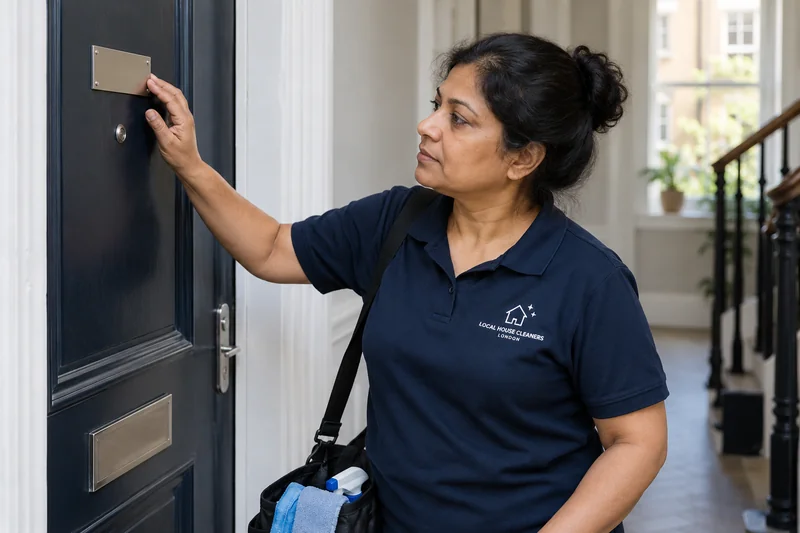
Agree the authorised residential entrance and secure handover, with a practical contact if you will be absent. A market address or public staff nearby should not be presumed responsible for access. If someone else will assist, settle their permission in advance. Keys should not be exposed, with confidential codes kept away from general room photographs and public notes.
Explain pets, occupied rooms and any restriction affecting the sequence. Household supervision and animal care are not implied by cleaning, while high access, heavy furniture movement and hazardous work need separate assessment. If the circumstances change, contact the agency so the revised request can be considered and confirmed rather than assumed to fit the original appointment.
If you decide during the visit that another task matters, first check how it affects the accepted priorities. Adding a laundry stage, for example, must not quietly remove the time needed for the bathroom. The agency needs the proposed action, any extra cleaner-hours and the complete charge accepted by an authorised contact before additional paid work starts. The cleaner also needs availability to do it. Where that cannot be settled, keep the agreed finish and consider a separate request for what remains.
Raise a concern by naming the agreed task, room and surface, with a focused private photograph where useful. Exclude people, documents, screens and security details. For a new Smithfield request, send complete residential details, priorities, frequency and preferred timing. We can assess suitable cleaner-hours, set out the full amount and confirm a useful service around the household work you want completed.
Need to compare the details? See more cleaning questions →
It concerns private domestic-cleaning requests around Smithfield. The market is a local landmark, not a service-site claim or an authorised entrance to a home. Give the exact residential address and full postcode, with the rooms and tasks you want assessed.
Yes, identify the permitted rooms and reachable work, with private areas kept outside the scope. We can assess suitable labour for that selection, subject to the standard service minimum. Additional fittings and household extras need explicit inclusion.
The handover must be agreed. A cleaner can carry out an assessed stage during the available time, but washing, drying and later handling are not guaranteed to finish within the cleaning period. Identify who takes over when the cycle ends.
Keep the initial list realistic and ask for any extra work to be assessed before it starts. The task, added labour, amount and cleaner availability must be agreed by an authorised contact. Without that agreement, the original scope and finish time remain in place.
Take a look around the area, then use your full postcode to plan a clean for your own home.
Area reference only. This map does not mark a company office or confirm service boundaries.
This embedded map is provided by Google, which receives connection information and may use cookies. Google privacy information.
Postcode districts help you browse. They overlap neighbourhood boundaries; your full address and available cleaner time still need checking.
Start with your postcode. We’ll plan the clean around your home.