Weekly cleaning
£24per cleaner-hour
3 hours minimum · £72 daytime basePlan weekly cleaning
Choose the household help that will be useful when the home returns to its ordinary routine after time away. For Cannon Hill, describe the selected rooms, actual condition and domestic work you want ready rather than assume an empty period calls for the same service everywhere. Local House Cleaners London can assess an appropriate contribution, suitable help and enough labour. You can review the complete proposal for the real appointment and arrange the preparation that makes it possible. The cleaner receives recognisable tasks, while personal unpacking, belongings and access decisions stay with the household instead of an undefined promise to get every part of life back in order.

Moving area names stop while hovered or focused. Press Enter or Space, or tap the moving area, to keep them still after leaving. Activate again to allow movement. Browse the directory for the complete list.
A regular helping hand, a proper reset or a clean before your next move. Choose the work your home needs.
Keep the kitchen, bathrooms and everyday rooms feeling cared for.
Explore regular cleaning02 ↗More time for reachable detail and the build-up that needs extra attention.
Explore deep cleaning03 ↗An agreed empty-property checklist, ready for your next chapter.
Explore tenancy cleaningA clear plan for your Cannon Hill home, from the jobs you need to an agreed visit.
Add your contact details and save your home address.
Pick your service, tasks and property details. Choose a date and start time, then check the full cost.
Top up from £35, with enough to cover the whole visit. The booking amount is reserved from your balance when you confirm.
Agree the plan and an available time. Your visit details stay in your account.
These are starting points. The final scope, timing and suitable cleaner availability need confirmation.
£24per cleaner-hour
3 hours minimum · £72 daytime basePlan weekly cleaning£26per cleaner-hour
3 hours minimum · £78 daytime basePlan fortnightly cleaning£28per cleaner-hour
3 hours minimum · £84 daytime basePlan one-off cleaning£35per cleaner-hour
4 hours minimum · £140 daytime basePlan deep cleaningEarly starts, late finishes and next-day requests can cost more. The full breakdown is shown before agreement. See timing prices and assessed extras →
Studio & 1 bed from £189 · 2 beds from £269 · 3+ beds & houses from £329
 Cannon Hill · SW20 / SM4
A clean is more useful when the cleaner knows exactly where to start. Pick your rooms, add your priorities and allow enough time for the work.
Ironing and laundry use the same booked time. A long checklist may need more than the minimum visit.
Build my cleaning planHouse, flat or studio—start with what matters most to you.

Start with the domestic result you would value after returning. You may want appropriate kitchen and bathroom care, accessible floors or another selected contribution while the household resumes its own routine. Name the actual actions and main priority. These are examples of useful choices, not assumptions about Cannon Hill homes or why somebody has been away. A cleaning request should describe the work you want to buy. The agency can consider a practical plan from the condition and quantities supplied, rather than a general return-home instruction being expected to include unpacking, personal organisation and every chore left for later.
Give the complete residential address and postcode, choosing House, Flat or Studio with any building or residence identifier. This page concerns Cannon Hill in Merton. The council places Cannon Hill between Raynes Park and Morden and identifies Cannon Hill Lane and Parkway among approaches to the Common. Those bounded local references do not establish your private entrance or room layout. Count selected bathrooms, separate toilets, internal levels and connecting spaces whose care is wanted. A public open space cannot reveal what work is present inside another home, so explain the particular household and tasks rather than rely on an area name alone.
Describe the condition you know, keeping uncertainty visible where the home has not yet been checked. Time away does not automatically establish ordinary upkeep, intensive work or a particular treatment. Significant grease, established deposits, damage or an unidentified concern should be described for assessment where present. Explain who can provide current information if that affects the request. The useful proposal should fit what the cleaner will actually find, not an ideal imagined state. You can choose a focused ready contribution and ask about another area once its condition or preparation can be explained more accurately.
Decide which parts of the household return remain yours. Personal bags, food decisions and stored belongings may need your own destinations before a selected surface or floor route becomes accessible. If suitable defined handling help would be useful, identify its objects, amount, permission and endpoint for assessment. A cleaner should not decide which contents can be discarded or where private possessions belong to expose the work. A realistic scope can still provide useful care in the areas ready, without assuming the whole home will be empty of personal activity before any domestic help can begin.
One-off domestic cleaning starts at £28 per cleaner-hour with a three-hour minimum, an £84 ordinary base before applicable additions. Four cleaner-hours have a £112 base, adding one hour for £28 above that minimum. The labour needs an assessed contribution it can support. Neither amount promises a particular room count or every return-home chore. Give the actual selected actions, condition and preparation so you can compare a focused result with a fuller appropriate allowance. The useful spending decision should concern the work available, rather than an account of time away being treated as a fixed formula for how long cleaning takes.
Deep cleaning begins at £35 per cleaner-hour with at least four hours for the assessed intensive scope. It should be chosen for the particular condition and purpose, not merely because the household has been elsewhere. Repair, restoration and specialist concerns need their own consideration. More labour cannot make every treatment suitable or guarantee a changed appearance for a damaged finish. Describe the actual concern and ask which contribution can be assessed. You may decide appropriate ordinary work is useful, request an intensive plan for identified areas or leave another question for separate assessment while ready domestic priorities receive attention.
Give the real service date and preferred start for the full amount, including applicable early, late, short-notice and holiday adjustments. If your return plans change, ask about the current proposal instead of assuming an earlier price or slot remains applicable. Suitable staffing and practical access need to fit the request too. A preferred timing is not confirmation of attendance. Choose the appointment actually offered before arranging another household person's day around it, with the work, readiness and complete amount understood rather than a travel estimate becoming the assumed start for an unconfirmed cleaning visit.
Customer top-ups begin at £35, with sufficient available balance needed for the full accepted reservation. Money reserved elsewhere and the history of charges or adjustments are different from funds available now. Funding alone does not assign a cleaner or approve another task. If the home's actual condition or requested contribution changes, review suitability, labour and the complete amount through the agency. Extra work, charges and overtime require prior agreement before proceeding. The customer keeps control of what help to buy, while the cleaner receives a coherent paid job rather than an open-ended instruction to continue until every aspect of the household return is finished.
Identify relevant materials in the selected areas. A floor, worktop and bathroom fitting may need different guidance. Share reliable manufacturer instructions where available and explain which surface each note belongs to. If a finish is unknown, keep that explicit. The agency can consider suitable care and any specialist question from accurate details. An earlier method used elsewhere in the property should not automatically carry onto an unrelated item. A return-home request is still a particular domestic job, requiring appropriate actions for the actual materials rather than a universal treatment based on the wish to refresh everything at once.
Describe physical wear and damage separately from dirt. A loose component, worn coating or damaged edge may affect handling even when suitable cleaning is also wanted nearby. Give the observation and known restriction without asking the cleaner to diagnose a cause or decide repair responsibility. Appropriate domestic care does not restore every surface, and additional paid time cannot guarantee every mark disappears. A useful proposal may support suitable work around an understood boundary while another issue receives assessment. Keep the expected contribution realistic rather than making the first visit responsible for every appearance concern noticed when the household returns.
The agency verifies and approves the cleaner's identity and suitability before the cleaner accepts work, with relevant task skills, coverage and available time considered for the assignment. Raise unusual handling, heavy movement, unsafe reach or specialist requirements during assessment. A familiar service label does not settle whether every new request is suitable. The company arranges approved products, cloths and protective equipment for the accepted work, with meaningful sensitivities and restrictions shared in advance. Accurate information gives suitable help a recognisable contribution and keeps technical questions visible, instead of a cleaner discovering an unspecified wider responsibility only after the household has organised its plans around attendance.
Confirm equipment expectations for the actual scope. For a later recurring domestic arrangement, the household supplies the agreed safe working vacuum, mop and bucket with essential parts and usable power or charge. Check that an essential tool has not become inaccessible, incomplete or faulty while the household setup changed. Raise gaps early so the effect can be considered. A usable agreed tool in a known accessible place is practical preparation; simply assuming equipment is still where somebody remembers it does not support the work. The appointment needs its actual setup ready, whether the contribution is occasional or part of a new routine.
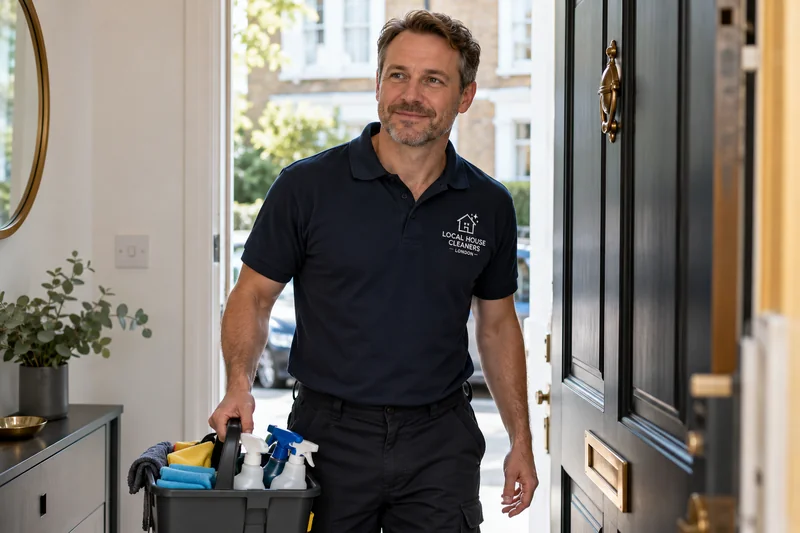
Choose an authorised person or process that can admit the cleaner for the accepted appointment. Give the complete home identifier, actual private entrance and relevant intercom information. A concise note may help where the doorway differs from the frontage a visitor first expects. Cannon Hill Lane and Parkway are local public references, not a default key point or permission to enter another premises. The cleaner needs a practical route into the correct residence. Check relevant building arrangements with the responsible person instead of relying on another resident happening to open a shared door when required.
If admission depends on somebody returning, explain the genuine arrangement rather than treat an uncertain arrival estimate as settled access. Another authorised representative may be able to provide a workable handover where appropriate. They need usable access, the current appointment details and the selected work. Keep a practical contact for difficulties. The useful plan should give the cleaner ready domestic tasks at the agreed start, not responsibility for coordinating several people whose own arrival or preparation remains unconfirmed. Raise a change through the agency promptly so another suitable contribution or arrangement can be considered if the original setup no longer works.
Share security information privately through the agreed process. Whoever admits the cleaner should know their role and whether they have authority to approve any change in work or amount. Providing access alone does not establish that spending responsibility. Point out the usable equipment and private boundaries in a short current handover. The cleaner cannot be expected to know which bags will be unpacked later, where personal contents belong or which of several earlier messages describes the request finally chosen. One clear brief connects the paid contribution with the actual household expecting it.
Settle departure too if you will be out at the finish. Explain the authorised security endpoint and key return or next holder arrangement, with a contact for a change in plans. Someone expected to receive a handover should know that responsibility. Keep a requested date and start distinct from an accepted booking. The household can organise its own return around the appointment actually confirmed through the agreed process, while later changes are considered on their practical facts rather than a cleaner being left to improvise admission, closure or an indefinite wait after the original contact becomes unavailable.
Choose which selected areas can be ready first. A bathroom or kitchen contribution may be useful before another room where personal contents still need attention. Give genuine room windows and an alternative agreed starting area where one exists. The agency can consider a practical sequence with sufficient labour, but not every task list and household restriction will fit an unchanged allowance. A focused useful contribution can be a deliberate choice. The cleaner should not have to decide which wider return-home activity matters most or coordinate every person's unpacking and room use while still promising all earlier outcomes.
Keep personal preparation connected to the particular work it enables. The household may clear an agreed floor route or put food in its chosen place without emptying every excluded room. If a preparation action will not happen, describe the actual accessible state and ask what suitable care can be supported. A cleaner should not make private storage or disposal decisions to achieve an ideal room layout. Useful domestic help can happen in ready areas while another household stage remains yours, with the accepted contribution honest about its starting point rather than dependent on an unplanned transformation before cleaning begins.
Separate linen readiness from the rest of the room plan. A specified bed change can be useful when matching clean sets and a used-bedding destination are ready. Another set still washing or drying has its own elapsed process and cannot be assumed available for every later stage during attendance. Describe the actual quantity and endpoint wanted. A limited useful hands-on contribution can be assessed without promising a complete clothing cycle. The household should know what remains for it after departure instead of an unconfirmed machine stage quietly extending the cleaner's responsibility beyond the labour bought.
Once ordinary use resumes, decide whether the next request should have the same purpose. Weekly domestic cleaning starts at £24 per cleaner-hour and fortnightly at £26, both with a three-hour minimum. Their future contribution should be assessed for normal workload and preparation rather than copied automatically from a one-off return occasion. You may prefer a focused recurring core or occasional suitable help. Explain the actual chores valued and keep the full proposal clear, allowing the service to fit the routine now being used instead of every earlier optional task becoming a permanent expectation without another decision.

For ironing, identify a prepared manageable garment group, relevant care labels and exclusions, safe tools and an available workspace. Decide where finished pieces belong. Personal bags should have their household sorting decisions settled before a ready group is presented for assessment. A cleaner should not be expected to unpack everything, decide what needs treatment and complete an undefined amount after the room priorities. Clothing care uses labour alongside cleaning. A clear selected quantity lets the customer compare a useful contribution and its full amount, retaining other personal stages without assuming every item associated with the return is included.
For laundry help, specify the actual hands-on stage and amount. Suitable dry items for folding, an appropriate machine action with settled instructions and putting completed pieces in a chosen place are distinct requests. Give the relevant destination and who handles any later household action. Machine programmes cannot promise all subsequent drying or storage becomes ready during the appointment. Useful limited help is still possible with an understood endpoint. The cleaner follows the contribution accepted, while the customer knows which part of the clothing or linen process it has bought instead of a broad category implying unlimited responsibility.
Other can explain another suitable domestic action precisely. You might ask about appropriate wiping of an identified empty indoor storage case's accessible exterior, giving its material, condition, quantity and intended handling for assessment. Its personal contents and destinations would be settled by the household. That is different from specialist treatment, unpacking or reorganising every item nearby. The example is not a prescribed method or automatic inclusion. A recognisable action and endpoint help the agency consider suitable labour, while a miscellaneous label should not turn an ordinary cleaning request into an unbounded household organisation project.
Bring additions through the agency before they extend the accepted job. A larger clothing group, another room or different handling can need more assessed labour, an explicit substitution or another arrangement. Extra charges and overtime require prior agreement before proceeding. Identify who can decide if the account holder will be unavailable. A representative's suggestion, a cleaner being present or money remaining in the account does not supply approval automatically. A clear choice keeps the work and amount understandable, letting the household buy another useful contribution without the appointment gradually expanding through informal expectations nobody has considered together.

Check the result against the actual selected actions and boundaries. A visit focused on appropriate kitchen and bathroom work should not be judged as though the whole household return process had been purchased. Remember excluded personal contents and any agreed access limitation. If a particular action seems incomplete, identify the location and what you observed. The customer does not need a technical diagnosis to bring a factual question to the agency. Clear details help distinguish concern about accepted cleaning, an existing physical defect and another task now wanted, rather than every unfinished household chore becoming a retrospective obligation.
Raise concerns promptly, within 48 hours where possible, to help establish the facts. This request does not remove statutory rights afterwards. Give the date, selected action and relevant observations about condition, guidance or access. A focused image may help through the agreed process while unrelated private possessions and security details remain out of view. Keep an uncertain cause separate from what is known. The appropriate response depends on the facts and assessment rather than a promise that more cleaning can repair any material or deliver every broader outcome someone associated with getting the home back to ordinary use.
Notice which practical choices made the appointment useful. A ready initial room, clearer equipment location or better contact can inform a later request. Update the relevant instruction rather than add another general demand to do more. If the next work or condition differs, ask for enough suitable labour to be assessed again. A recurring arrangement should describe the home as it is normally used, while another occasional contribution can have its own purpose and amount. This gives the cleaner current relevant tasks and the household a clear view of the help actually chosen instead of an indefinite list inherited from one unusual occasion.
Begin your Cannon Hill enquiry with the complete address, chosen service, actual date, preferred start and proposed hours. Explain the domestic result wanted, selected areas and current condition, with preparation, care guidance and authorised access made clear. Local House Cleaners London can assess suitable help and a complete proposal for you to consider. Choose the practical contribution and prepare its agreed essentials, bringing later changes through the agency. The home can receive useful attention as ordinary life resumes, with personal decisions, later household stages and the spending commitment understood alongside the cleaner's actual paid job.
Need to compare the details? See more cleaning questions →
Yes. Merton Council places Cannon Hill between Raynes Park and Morden and identifies Cannon Hill Lane and Parkway among approaches to the Common. Give your own complete residential address and postcode, with the private entrance and home identifier, so the actual request is clear.
Describe the actual condition and purpose. Ordinary suitable work, an intensive concern and a specialist question require their own assessment. Deep cleaning starts at £35 per cleaner-hour with a four-hour minimum for its assessed scope; time away alone does not establish the appropriate service.
Explain a genuinely workable admission plan and the actual date and preferred start. Suitable staffing, ready tasks and practical access need assessment. A travel estimate or requested timing is not confirmation, so choose the appointment offered and update changes through the agency.
Identify the domestic actions wanted and settle personal sorting and destinations within the household. If a suitable defined handling action would help, describe its objects, quantity, permission and endpoint for assessment. A general return-home request should not imply unlimited organisation or clothing stages.
Take a look around the area, then use your full postcode to plan a clean for your own home.
Area reference only. This map does not mark a company office or confirm service boundaries.
This embedded map is provided by Google, which receives connection information and may use cookies. Google privacy information.
Postcode districts help you browse. They overlap neighbourhood boundaries; your full address and available cleaner time still need checking.
Start with your postcode. We’ll plan the clean around your home.