Weekly cleaning
£24per cleaner-hour
3 hours minimum · £72 daytime basePlan weekly cleaning
A recurring cleaner should take a recognisable share of the household work off your week. On Rowan Road, start with the chores that keep becoming difficult to fit in, then decide what you can make ready for someone else to handle. Local House Cleaners London can assess that contribution, the suitable skills and a realistic appointment. The aim is a repeatable domestic arrangement with clear choices: useful work at the agreed home, enough cleaner time for the selected stages, and a price you have reviewed for the actual date.

Moving area names stop while hovered or focused. Press Enter or Space, or tap the moving area, to keep them still after leaving. Activate again to allow movement. Browse the directory for the complete list.
A regular helping hand, a proper reset or a clean before your next move. Choose the work your home needs.
Keep the kitchen, bathrooms and everyday rooms feeling cared for.
Explore regular cleaning02 ↗More time for reachable detail and the build-up that needs extra attention.
Explore deep cleaning03 ↗An agreed empty-property checklist, ready for your next chapter.
Explore tenancy cleaningA clear plan for your Rowan Road home, from the jobs you need to an agreed visit.
Add your contact details and save your home address.
Pick your service, tasks and property details. Choose a date and start time, then check the full cost.
Top up from £35, with enough to cover the whole visit. The booking amount is reserved from your balance when you confirm.
Agree the plan and an available time. Your visit details stay in your account.
These are starting points. The final scope, timing and suitable cleaner availability need confirmation.
£24per cleaner-hour
3 hours minimum · £72 daytime basePlan weekly cleaning£26per cleaner-hour
3 hours minimum · £78 daytime basePlan fortnightly cleaning£28per cleaner-hour
3 hours minimum · £84 daytime basePlan one-off cleaning£35per cleaner-hour
4 hours minimum · £140 daytime basePlan deep cleaningEarly starts, late finishes and next-day requests can cost more. The full breakdown is shown before agreement. See timing prices and assessed extras →
Studio & 1 bed from £189 · 2 beds from £269 · 3+ beds & houses from £329
 Rowan Road · SW16 / CR4
A clean is more useful when the cleaner knows exactly where to start. Pick your rooms, add your priorities and allow enough time for the work.
Ironing and laundry use the same booked time. A long checklist may need more than the minimum visit.
Build my cleaning planHouse, flat or studio—start with what matters most to you.

Think about the part of home care you would most welcome help with next week. It might be cleaning the bathroom and suitable floors, keeping accessible kitchen surfaces manageable, or a selected mix of dusting and clothing care. Write those actions down in priority order. A recurring arrangement works better when its purpose can be described in everyday terms: the cleaner handles these tasks and the household keeps responsibility for these other things. You can ask for a useful contribution without presenting every domestic obligation as one unlimited cleaning request.
For local orientation, Merton Council locates Rowan Road Recreation Ground on Rowan Road in SW16. That public reference helps identify the road; your full residential address and postcode identify where the work is requested. Include the house number, flat or studio identifier, relevant entrance and property type. Homes near the same public place can need very different amounts of labour. The recreation ground does not tell us how many bathrooms you have, where your vacuum is kept or which household member can authorise access. Describe those details directly when they affect the job.
Separate an everyday need from a backlog that has developed over time. If the kitchen needs ordinary upkeep but a shower has substantial deposits, say so. The agency can assess whether the shower belongs within the proposed domestic contribution or needs a different intensive scope. You can still choose useful suitable work for the other selected areas. Describing the starting condition gives the enquiry a practical footing and helps avoid booking an ordinary allowance for a substantially different concern simply because both jobs take place in familiar rooms.
Count what the request actually contains. Two bathrooms and a separate toilet are three spaces to consider; an upstairs landing adds a floor route; several ready ironing items add another hands-on stage. Mention rooms that are excluded as well as those selected, especially where another resident works or rests. A priority list is not permission to skip everything below its first line without discussion. Its value is helping the agency propose enough suitable work and explaining which outcome matters most if the original choices need adjustment during assessment.

Weekly domestic labour starts at £24 per cleaner-hour and fortnightly at £26, with a minimum three hours for either appointment. At their ordinary minimums, the respective bases are £72 and £78. Compare the contribution that time is intended to support. A household may prefer weekly help with a compact core, while another request needs a longer appointment or a different division of work. Neither frequency guarantees that every room, clothing stage and occasional intensive task will fit inside its minimum. The proposal needs to reflect the actual request and starting condition.
Four hours of fortnightly labour has a £104 ordinary base, compared with £78 for three hours. That additional £26 buys another cleaner-hour, subject to suitable work and the offered arrangement. It does not buy a guaranteed result for an unidentified stain or permission to use an unknown product. If occasional work is the better fit, one-off domestic cleaning begins at £28 per hour with a three-hour minimum. Assessed deep cleaning starts at £35 per hour with at least four hours. The service choice should follow the work you need help with.
Give the service date, preferred start and available access window so the agency can explain applicable early, late, short-notice or holiday additions. Review the full proposed charge alongside the labour and scope. An ordinary rate example helps you compare options but is not the complete price for every date. A request for a particular time also needs a suitable cleaner and an actual offered appointment. You can make an informed decision when timing, contribution and total appear together, with any change to one considered before the arrangement is accepted.
The account can distinguish funds available now, money reserved for an accepted booking and the history of charges or adjustments. Top-ups start at £35; enough available balance is needed to cover the full accepted reservation. A top-up is a funding action, not a separate approval for more labour or a promise of attendance. Keep the booking proposal as the reference for what the money supports. When you change frequency, duration or work, ask for the revised details and complete amount so the account follows the arrangement you actually chose.
Good recurring instructions explain how the work can be carried out safely and usefully in this home. Identify any care guidance for selected surfaces, finishes or appliances and pass on relevant exclusions. A cleaner cannot establish the correct treatment from a photograph of the room alone. If you do not know the material, describe what you can observe and say that the care information is uncertain. The agency can assess the request with that limitation visible, without an ordinary cleaning appointment becoming a promise to repair damage or restore an unfamiliar finish.
For the recurring domestic arrangement, the household supplies the agreed safe working vacuum, mop and bucket; the company arranges approved products, cloths and protective equipment. Before the visit, check that your equipment is usable, complete and accessible. A vacuum with its head missing cannot perform the same work as one ready to use. Explain where suitable power and the agreed storage are, and make those routes available. Giving the cleaner a clear task and ready equipment protects useful appointment time and reduces avoidable uncertainty at the start of a recurring visit.
Mention practical factors that alter the requested method. An area containing delicate objects may need those objects moved by the household before accessible dusting can take place. A room may contain a surface whose care instructions exclude a particular approach. A floor route may need a safe sequence while residents are using another space. These details support a suitable task discussion; they do not require you to diagnose a professional treatment yourself. The agency should understand the limits and skills required before offering someone for the agreed work.
The agency verifies and approves the cleaner's identity and suitability before the cleaner accepts work. Relevant tasks, coverage and practical availability also have to fit the proposal. Tell the agency if the request includes a skill such as ironing, since a general request for cleaning does not communicate that separate requirement. If the eventual brief changes, its suitability may need checking again. A cleaner approved for the agreed ordinary contribution should not encounter an undisclosed specialist treatment or an unsafe access method presented as an automatic extension of that first arrangement.
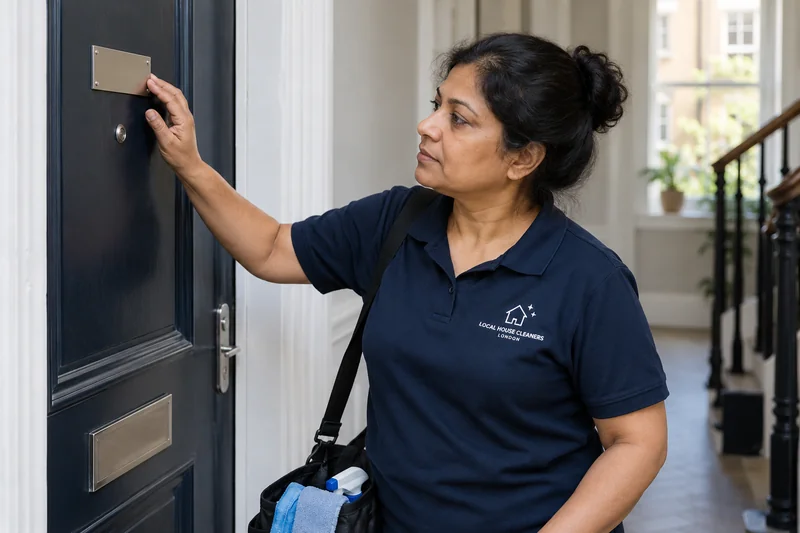
Prepare one consistent arrival instruction for the actual address. State the bell or entrance identifier, who will provide access and what happens if the customer is away. Include a usable way to reach the responsible person through the agreed agency arrangement. A reference to the recreation ground may help someone recognise the road, but the last steps to a particular home need the residential details. Access through a shared doorway, gate or managed entrance should be authorised rather than assumed from another person's usual route into the building.
Choose an opening sequence that makes sense for the household. If someone needs the bathroom shortly after the appointment begins, raise that timing in advance. If a particular room becomes available later, explain its realistic window so the agency can assess whether it fits. Avoid planning two incompatible uses of the same space and expecting the cleaner to solve the conflict on arrival. A useful arrangement joins the agreed start with rooms, people and equipment that will actually be ready, leaving less of the appointment to negotiate outside a closed door.
Keep essential care and boundary instructions easy to locate. The cleaner should know which rooms are included, which cupboard holds agreed equipment and which items or surfaces are excluded. A short accurate brief is more useful than several conflicting messages from different residents. Where household members share the home, agree who can change the instructions or authorise extra spending. That decision matters when a cleaner is offered another task by someone who was not involved in the booking. Clear responsibility lets practical questions reach the right person promptly.
Plan the end of access as carefully as its beginning. Say which doors should be secured, where authorised keys or agreed items should go, and whether a particular room needs to remain available for the next resident. Do not include unnecessary personal details in general location notes. The useful information concerns the agreed home and work. If an arrival problem occurs, contact the agency with the concrete issue and any updated instruction; a cleaner waiting outside cannot turn that lost access into an automatic extension of labour or a guaranteed later finish.

Recurring help is easier to sustain when the household knows what must be ready before each appointment. Choose practical preparation that you can repeat: remove personal items from the selected bathroom surfaces, identify the kitchen area to be cleaned and make the agreed floor routes reachable. This is not a demand to clean the home before the cleaner comes. It is a division between handling possessions and carrying out the selected cleaning stages. If you need help with an additional domestic action, describe it so its suitability and time can be considered openly.
Clothing care benefits from its own simple definition. For ironing, identify a ready group of suitable items, relevant labels or exclusions, safe agreed equipment and where finished items belong. The number and condition of items matter more than the word ironing on its own. For laundry, choose the hands-on stage you want considered, such as dealing with an agreed ready load. Machine running time does not equal cleaner labour or guarantee that every washing and drying stage will finish within the appointment. Keep the requested contribution proportionate to the actual preparation.
A recurring visit can keep its main purpose while some suitable priorities change. If a guest room becomes occupied or one resident starts working in a selected space, tell the agency what that changes for access and tasks. A room that was available previously is not automatically available at the next appointment. You may choose another suitable contribution or request a revised arrangement. A repeat customer should still have a current brief, with the cleaner able to tell what remains the same and what has deliberately changed for that visit.
After the first appointment, consider whether the routine is practical for you. Did the prepared core address the chores you most wanted handed over? Was a selected task consistently blocked by possessions or room use? Use those observations to discuss the next scope or labour allowance. The solution may be better preparation, a clearer priority or more time, rather than adding pressure to an unchanged minimum. Adjustments should remain specific and agreed, with the appointment still a finite contribution and no assumption that repeat work guarantees the same individual or an automatic rearranged date.
One useful household habit is to agree a single preparation check before the appointment: selected rooms available, personal contents dealt with, equipment reachable and any changed instruction communicated. Each resident can take responsibility for their own possessions while one person keeps the booking brief consistent. If that check reveals a problem, tell the agency what remains possible. A bedroom being occupied does not necessarily prevent an agreed bathroom contribution, but the cleaner needs a current authorised plan rather than being expected to choose a replacement task independently.
An occasional task can be worthwhile when its scope is clear enough to assess alongside the recurring work. Use Other to explain the action you want, the quantity, material or care information, preparation and a useful finish point. A request to clean an emptied refrigerator shelf differs from permission to sort food, discard belongings or dismantle fittings. State what the household will decide and prepare. That makes the additional work understandable without leaving the cleaner to infer personal choices from an untidy or unfamiliar area during an ordinary appointment.
Think about what should happen to the existing core if the new contribution needs substantial labour. You might keep the bathroom and floor care intact and request more time for an assessed extra, or seek a separately defined appointment. Merely adding a line to a task list does not create more hours. The agency can consider suitability, duration and the revised full amount before offering a change. This discussion is especially useful when the occasional concern has a different condition or method from the recurring work, even though it sits in the same kitchen or bedroom.
Overtime needs prior agreement before the cleaner continues beyond the accepted arrangement. If useful work remains, describe the remaining stage and ask what additional labour and charge would be required. The customer should be able to decide whether to proceed with that specific proposal. An unfinished optional task, a funded account or a cleaner still being present is not a standing instruction to spend more. Keeping the decision explicit helps the cleaner know where the authorised job ends and allows the customer to balance the value of further work against its actual cost.
If there is not enough usable time for the proposed addition, keep the agreed boundary and discuss a future suitable arrangement. For example, a partly prepared clothing group may be better reconsidered when the household can identify labels, exclusions and a destination for the finished items. That is a planning choice rather than permission to improvise care or rush through an unknown quantity. The recurring service remains useful because its original purpose is protected, while occasional work can receive the preparation, skills and labour it requires when the customer chooses to add it.
Keep important scope changes with the agency so the customer, cleaner and current proposal refer to the same work. Describe which appointment and task the message concerns, what has changed and what decision you need. A request for extra labour, a note about an occupied room and a question about a charge need different responses. Precise messages make it easier to consider the right issue without guessing from a general instruction to improve everything. The agency can assess the next step using the agreed contribution and the circumstances you actually report.
If a concern relates to the completed work, identify the selected task and the specific observation. A floor route left inaccessible by household items raises a different question from an agreed reachable surface apparently not attended to. Share useful relevant photographs where appropriate, avoiding unnecessary views of private documents or unrelated possessions. The aim is to explain the concern, not require the customer to prove a specialist cause. The agency can consider what was agreed, what was ready and what was observed when deciding how to respond to that particular appointment.
Please report concerns within 48 hours where possible so the details are easier to review; this request does not reduce statutory rights. Distinguish a concern about the agreed service from a new wish for different work. Asking for another room to be included next time is a fresh scope discussion, while reporting a possible omission in the first brief should be considered on its own facts. Do not assume that booking another paid visit is a necessary remedy. Explain the issue and let the agency address it through the appropriate process.
To begin, provide your Rowan Road residence details, property type, preferred date and start, and the chores you most want help with. Include the starting condition, care limitations and what will be ready. Local House Cleaners London can then assess the contribution, relevant skills, realistic labour and complete proposed amount. You can review the offered arrangement, fund the accepted reservation appropriately and prepare a clear first brief. That gives recurring home help a practical foundation: a household decision translated into suitable agreed work, with a place to raise changes and concerns as the routine develops.
Need to compare the details? See more cleaning questions →
Use your complete residential address and postcode, including the flat or studio identifier and authorised entrance details. Merton Council's Rowan Road Recreation Ground reference identifies the road in SW16; it does not identify the home or establish its access arrangements.
You can request both for assessment. Define a ready ironing group and the room tasks, care information and equipment so suitability and enough labour can be considered. Fortnightly cleaning starts at £26 per cleaner-hour with a three-hour minimum; the complete dated price reflects the actual accepted arrangement.
Choose the useful contribution and keep the brief current. Explain changed room access or requested priorities through the agency. A different or larger scope may require revised labour and cost; extra tasks and overtime need prior agreement before proceeding.
A top-up adds funds. The offered appointment still needs suitable staffing and acceptance, and available balance must cover the full accepted reservation. Funding does not approve extra work or confirm attendance on its own.
Take a look around the area, then use your full postcode to plan a clean for your own home.
Area reference only. This map does not mark a company office or confirm service boundaries.
This embedded map is provided by Google, which receives connection information and may use cookies. Google privacy information.
Postcode districts help you browse. They overlap neighbourhood boundaries; your full address and available cleaner time still need checking.
Start with your postcode. We’ll plan the clean around your home.